
This article aims to analyze the production of open access scientific journals and public policies for their dissemination in Latin America. Open access offers greater visibility to scientific research and therefore the information derived from it is the key to the development of countries and the well-being of society. The study was framed in the documentary review type methodological approach, focused on descriptive, longitudinal, and retrospective research, with a quantitative research perspective. To provide an approach to the subject, a database exploration and bibliographic review were carried out, focusing on the measurement of the production of open access journals and public policies in the area in order to promote the internationalization of knowledge. The Scimago Journal & Country Rank database was consulted to obtain the main indicators of publication of open access journals. As a result, in the last five years, Latin America shows an increase of 10.74% of open access scientific journals. There is also evidence of interest in improving public policies that are still under review, in an environment where the state is the regulatory entity in education, research, and development.
El objetivo de este artículo es analizar la producción de revistas científicas en acceso abierto y las políticas públicas para su difusión en Latinoamérica. El acceso abierto ofrece mayor visibilidad a las investigaciones científicas, la información derivada de estas investigaciones es clave para el desarrollo de los países y el bienestar de la sociedad. El estudio se enmarco en el abordaje metodológico de tipo revisión documental, centrado en la investigación descriptiva, longitudinal y retrospectiva, alineada a la perspectiva de investigación cuantitativa, en procura de brindar un acercamiento al tema, se efectuó la exploración en bases de datos y revisión bibliográfica, centrando su atención en la medición de la producción de revistas de acceso abierto y las políticas públicas en el área con el fin de promover la internacionalización del conocimiento. Se consultó la base de dato Scimago Journal & Country Rank para la obtención de los principales indicadores de publicación de revistas en acceso abierto. Como resultado en los últimos cinco años Latinoamérica presenta un aumento en la cantidad de revistas científica de acceso abierto del 10,74%, se evidencia además el interés por mejorar las políticas públicas que aún están en revisión en un entorno donde el Estado es el ente regulador en educación, investigación, y desarrollo. Palabras clave:
Knowledge is part of the research process, man's curiosity product and it is acquired in official institutions that provide education and lead to obtaining a degree in some area. However, if scientific knowledge is not materialized through documents such as books, articles from indexed journals or other means, it is not considered a scientific production, and it then becomes one more document within the institution or organization that produces it. to be reviewed only by those who have access to it.
Scientific production includes a set of academic activities that require education and training of those who investigate. It is a joint effort carried out by the researcher(s), tutor and institution(s). Hence, "international scientific cooperation contributes not only to the progress of knowledge, but also to the construction of peace" (United Nations Organization for Culture, Science and Education [UNESCO for its acronym in Spanish], s.f.). That is why, in order to build peace and knowledge among nations, it is necessary to promote cooperation, share scientific results and establish mechanisms such as public policies.
In order to achieve cooperation among nations, open access is one of the key elements within open science. It refers to free access to scientific knowledge as long as the authorship and the source are mentioned; to order to favor all those interested, especially the less well-off. In this sense, the Budapest initiative proposed in 2002 for open access establishes two main ways to share the results of scientific research. The first is the golden way; this consists of the editor of a journal publishing the works under the open access modality; the second is the green path or “self-archiving”, which consists of depositing previously published works in an open access repository. Currently, 20 years after the Budapest declaration, the committee maintains the initial recommendation of hosting scientific production in an open infrastructure where distribution is favored and authors are not excluded for economic reasons. In agreement, Araiza et al. (2019) point out that "some scientific societies began to exploit the commercial value of their own journals, and as a result of this phenomenon, the scientific and academic communities began to promote different open access projects for journals specialized” (p.201).
To promote the dissemination of scientific results in Latin America, public policies have been established to legitimize and enrich each participant´s action in favor of free access to scientific research, without leaving out the criteria of social relevance. At the level of Latin America, De Filippo and D'Onofrio (2019) consider public policies in open science to be incipient, where institutional and cultural changes are required to achieve a more inclusive society. For their part, Torres-Melo and Santander (2013) define public policies as a relationship between the state and citizens, indicating that public policies "are the reflection of the ideals and desires of society, they express the objectives of collective well-being" (p.15). In addition, these policies include various actors: the state, society, politics, civil society, non-governmental organizations, among others (Wilson, 2018, p. 41).
The reflection of the above, leads us to ask the following question: Which of the two ways to disseminate of scientific results would be the ideal? Neither one nor the other, they are simply alternatives, and each publisher or organization will analyze, depending on the content and impact in the population, one or the other or reinvent a new one. The truth is that, by using open access routes, publications and content repositories are adapted to a global standard. It seeks to prioritize access to the results of research published in journals, in order to compete on equal terms by increasing editing processes, visibility of scientific publications, citations to researchers and their productivity, among others. Therefore, by adapting the contents to free access, a fair comparison between specialized journals is facilitated, indicating a high rate of production and visibility.
In this sense, this paper aims to analyze the production of open access scientific journals and public policies for their dissemination. The analysis is carried out in four Latin American countries: Brazil, Colombia, Argentina, and Chile, during the years 2017 to 2021.
The article is structured in four (4) sections. The first contextualizes the study situation, the second covers the research methodology, the third section presents the results and the fourth section, the conclusions.
This article considers the open access public policies that must be specified in actions towards open access scientific production at the national and international level, agreed and legislated through the state, society, politics, civil society, non-governmental organizations, among others.
From this framework of action, it seeks to encourage researchers to publish their productions in accredited and indexed journals under the Open Journal Systems (OJS) platform, in order to have open and free access to full text content, either for acquire information as a reader or researcher, delve into an area of interest, find answers to concerns, innovate in other topics, exchange scientific knowledge, among others, for the progress and development of science. In order to achieve these objectives, public policies must be adapted to follow up, supervise and evaluate the indicators of scientific and technological visibility.
Knowledge of public policies by institutions or research institutes leads to glimpse a panorama that transcends the regional and national to international spaces, which leads to contemplate the fundamental aspects in contextualizing of the subject of study.
Next, the theoretical referents of the research are presented.
Repositories are "services offered by an institution to members of its community for the management and distribution of digital materials created by the institution and its members" (Barrueco et al., 2021, p.37). Information can be accessed immediately through repositories. Repositories have evolved from the internal systems that exist in libraries to other more complex ones, for use outside the institution or grouped by areas. The institutional repository, being the closest mechanism to the researcher, is considered the primary source of their work that contains investigative work. However, according to Andrés et al. (2020), "the use of a university repository will be the result of a reformulation of the research and teaching tasks, which implies a resignification of the habits, perceptions, and knowledge of the teacher-researchers." (p.47)
Open access means at no cost to any user, without technical obstacles to publications, they can be read online, downloaded and printed, with additional rights such as the right to copy, distribute, search and link (Facilitate Open Science Training for European Research [FOSTER, 2018). In addition, "open access is understood as the possibility of accessing knowledge and cultural heritage approved by the scientific community through the internet" (op. cit, Andrés et al., 2020, p.36). Open access requires a coordinated effort between the various actors both to receive information from researchers and to disseminate it. Two ways are proposed to disseminate, the first is the green way or repositories and the other is the golden way through publication in open access journals.
The portals in Latin America maintain a non-commercial open access structure where publication and distribution are done free of charge and have been financed with public funds. The collections are managed in a decentralized manner and maintained by national institutions related to the promotion and support of scientific research and the communication of results (Bojo-Canales et al., 2020). In the 1990s. Latin America began its advance in the development of databases to promote open science through the creation of Latindex, SciELO and Redalyc. Later, in 2001, the appearance of free software such as OJS, for the management of scientific journals; along with the development of repositories for internal dissemination in educational institutions within their library system; and the advancement of computer technology, became external dissemination systems for scientific production financed with public resources in each country; in this sense, Salatino and Banzato (2021) express the following:
As for the repositories, they are in clear expansion, although an automatic harvest has not yet been institutionalized, nor have comprehensive policies been established for all the universities, with which in some cases the development of the academic units that comprise it are disparate ( p.105).
Therefore, in Latin America, both public policies for financing scientific research and policies within universities that promote and reflect internal scientific production are of great importance.
In Latin America, the state fulfills the functions of a planning, regulatory, and subsidiary entity of society. In turn, the state governs public policies in search of social welfare, economic development, and security for the achievement of these objectives. In this regard, Torres-Melo and Santander (2013) define public policies as the “main instrument of State action in its aspiration to transform a situation or behavior” (p.29).
In relation to scientific production in the region, public policies are oriented towards agreed and legislated actions through the state, society, politics, civil society, non-governmental organizations, among others, to encourage open access and cooperation between nations. From this perspective, it seeks to promote research production in accredited and indexed journals with open and free access that allow access to full-text content for scientific exchange, progress, and development of science.
The SCImago Research Group ranking qualifies the greatest weight to the research factor of the institutions. Its function is to present a detailed profile of the research activity. This ranking offers a classification of the publications in journals indexed in Scopus, based on the performance of three fundamental factors: research (it constitutes 50% of the composite indicator), innovation (30%) and social impact (20%). In this ranking, the highest percentage of measurement is given to publications in journals with a Scopus index, with the research factor being the most important. Scimago provides indicators to evaluate and analyze scientific production, it also allows the analysis of countries individually or grouped by region. It integrates a large amount of information where "Citation data is extracted from more than 34,100 titles from more than 5,000 international publishers and country performance metrics from 239 countries around the world" (SCImago, s.f).
This study was carried out from the perspective of quantitative research, based on the search, selection, reading, registration, organization, description, analysis and reflection of the conceptual and epistemological references. A documentary review was carried out which allowed describing and contrasting the relevant and necessary information to achieve the stated purpose (Hernández et al., 2014). In this sense, the exploration of databases was carried out from 2017 to 2021, focusing on open access journals at the global and Latin American levels, as well as on the global innovation index for the selected Latin American countries. In addition, an analysis of the public policies of these countries was carried out.
The research is descriptive, longitudinal, and retrospective. Descriptive studies specify the important properties of the groups or phenomenon under analysis. The longitudinal design collects data over time in specific periods to make inferences regarding the variation, in terms of the retrospection of events that have already occurred collected from files (Hernández et al., 2014). The scientific production published in the Scimago Journal & Country Rank (SJR) database and the Journal Ranking category over a five-year period (2017-2021) were analyzed. The search was carried out in June 2022. The SJR portal is useful to evaluate scientific publications based on the impact Index. Additionally, according to Rodríguez et al. (2019), "SJR constitutes an alternative to interpret scientific and technological advances in the society” (p. 60). From this context, it is necessary to prioritize public policies around research production and access to research results available to world knowledge.
Likewise, the "Journal" type filters and the "Only Open Access Journal" access were selected worldwide and in Latin America from 2017 to 2021. Latin American countries with positive percentage variation in at least two years between 2017 to 2021 of open access journals were selected for the analysis of public policies. As a research technique, the collection of documentary information with an exploratory scope was used; it was registered for each year: the country and open access journals grouped by country.
Descriptive statistics were performed to present the results in graphs and tables to analyze each item. The review under study was made up of the scientific production of open access journals worldwide. The analysis was focused on Latin American countries, including: Brazil, Colombia, Chile, and Argentina.
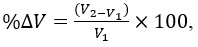
The SJR database of open access scientific journals worldwide made up of 106 countries was consulted to know the behavior that open access has had during the last five years (the period from 2017 to 2021). Graph 1 shows the number of open access journals and their annual percentage variation, for this the following formula was used:
Graph 1. Number of open access journals worldwide.
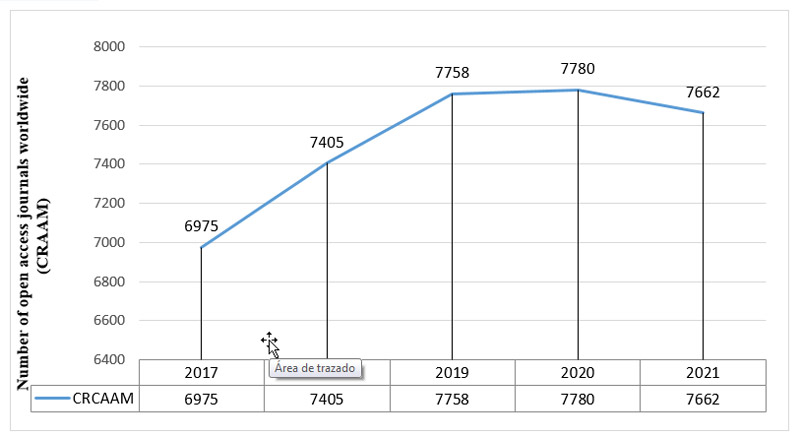
In the analysis of Graph 1, an increase of 9.85% of open access scientific journals is observed in the year 2017 compared to the year 2021. During the first four years (period 2017-2020) a positive trend was evidenced in the number of open access scientific journals, while by 2021 there was a 1.52% decline in the number of open access publishing journals globally. To conclude the study, Table 1 presents the totals of publications in general and open access worldwide represented by the data of 106 countries contained in the SCImago portal and its percentage calculated based on the totals above.
Table1. Number of total and open access journals (oa, by its acronyms in english) during the period 2017-2021 in the world context.
| Worldwide | 2017 | 2018 | 2019 | 2020 | 2021 |
|---|---|---|---|---|---|
| Total of Journals | 25873 | 26810 | 27198 | 26496 | 26356 |
| Total of OA Journals | 6975 | 7405 | 7758 | 7780 | 7662 |
| Open Access (%) | 26.96 | 28.62 | 28.52 | 29.36 | 29.07 |
Analyzing world production, Table 1 shows the number of total journals (including open access journals) and the total number of open access journals. By calculating the percentage of open access journals for each year, it is observed that in 2021, 29.12% of the production corresponded to open access journals, the trend is to increase during the period analyzed with 9.85% percentage variation between 2017 and 2021. Table 2 considers the same data, but in the Latin American context.
Table 2. Number of total and open access journals (OA, by its acronyms in english) during the period 2017-2021 in the context of latin america.
| Latin American | 2017 | 2018 | 2019 | 2020 | 2021 |
|---|---|---|---|---|---|
| Total of Journals | 844 | 886 | 919 | 922 | 931 |
| Total of OA Journals | 745 | 780 | 811 | 824 | 825 |
| Open Access (%) | 88.27 | 88.04 | 88.25 | 89.37 | 88.61 |
In this sense, the percentage variation between 2017 and 2021 was 10.74%. Table 2 shows that 88.61% for the year 2021 belongs to the production of open access scientific journals. Compared to the global percentage for the same year shown in Table 1, this value is higher, however, not all Latin American countries according to SJR showed growth during the period studied. Table 3 below shows the Latin American countries and the number of open access journals during the period under study.
Table 3. Number of open access scientific journals in Latin America.
| Country | Year | Δ% | Δ% | |||||||||
|---|---|---|---|---|---|---|---|---|---|---|---|---|
| 2017 | 2018 | 2019 | 2020 | 2021 | 2017 2018 |
2018 2019 |
2019 2020 |
2020 2021 |
2017 2021 |
|||
| Argentina | 50 | 54 | 58 | 59 | 59 | 8.00 | 7.41 | 1.72 | 0.00 | 18.00 | ||
| Bolivia | 0 | 0 | 0 | 1 | 1 | 0.00 | 0.00 | 0.00 | 0.00 | 100.00 | ||
| Brazil | 340 | 356 | 364 | 373 | 371 | 4.71 | 2.25 | 2.47 | - 0.54 | 9.12 | ||
| Chile | 96 | 99 | 106 | 107 | 108 | 3.13 | 7.07 | 0.94 | 0.93 | 12.50 | ||
| Colombia | 95 | 105 | 111 | 114 | 118 | 10.53 | 5.71 | 2.70 | 3.51 | 24.21 | ||
| C. Rica | 3 | 3 | 6 | 7 | 7 | 0.00 | 100.00 | 16.67 | 0.00 | 133.33 | ||
| Cuba | 24 | 24 | 25 | 24 | 24 | 0.00 | 4.17 | - 4.00 | 0.00 | 0.00 | ||
| Ecuador | 2 | 3 | 3 | 4 | 4 | 50.00 | 0.00 | 33.33 | 0.00 | 100.00 | ||
| Jamaica | 1 | 1 | 1 | 1 | 1 | 0.00 | 0.00 | 0.00 | 0.00 | 0.00 | ||
| Mexico | 93 | 94 | 93 | 94 | 94 | 1.08 | -1.06 | 1.08 | 0.00 | 1.08 | ||
| Peru | 8 | 9 | 13 | 13 | 13 | 12.50 | 44.44 | 0.00 | 0.00 | 62.50 | ||
| P. Rico | 1 | 1 | 1 | 1 | 1 | 0.00 | 0.00 | 0.00 | 0.00 | 0.00 | ||
| Uruguay | 1 | 1 | 1 | 1 | 1 | 0.00 | 0.00 | 0.00 | 0.00 | 0.00 | ||
| Venezuela | 31 | 30 | 29 | 25 | 23 | -3.23 | -3.33 | -13.79 | -8.00 | - 25.81 | ||
| Total | 745 | 780 | 811 | 824 | 825 | 4.70 | 3.97 | 1.60 | 0.12 | 10.74 | ||
Table 3 summarizes the number of open access scientific journals by country, in the period 2017 to 2021 and its annual variation. As a Result, few countries present a positive percentage variation in the period considered. Some did not present any variation (Bolivia, Jamaica, Puerto Rico and Uruguay); however, Venezuela is the only country in the region that has maintained an annual decrease with a variation of -25.81% from 2017 to 2021. A comprehensive aspect for Latin America shows an increase in the sustained annual percentage variation, with an increase of 10.74% for the region in the period considered.
The countries considered for the purpose of this study are the ones with an increase in their percentage variation, at least in two consecutive periods or not, and that vary from each other that is, those that presented an upward trend during the period 2017 to 2021 and additionally, those whose growth was greater than one (1) journal from the beginning of the study period. These resulting countries are shown in Graph 2.
Graph 2. Countries with positive percentage change in two years or more.
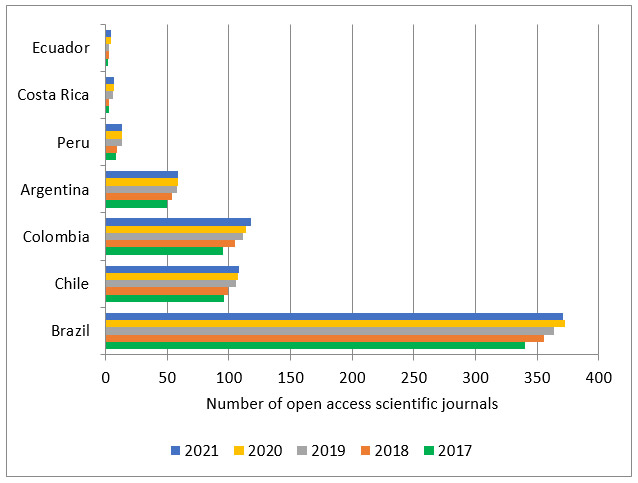
Chile and Colombia stand out in Graph 2, as the countries that have maintained sustained growth during the studied period, including an increase in their open access scientific production in 2021, the only two in Latin America to maintain annual growth as observed in Table 3. Next, the public policies implemented in Argentina, Brazil, Chile, and Colombia, countries with the largest number of open access scientific journals from 2017 to 2021, are analyzed.
Argentina was the second country in Latin America to pass national legislation related to the issue of open access. Through Article 75 of the Constitution of the Argentine Nation of 1994, the following are established as powers of Congress: research, scientific and technological development, its dissemination, and use. In relation to open access, Law 26,899 of 2013, called "Open Access Institutional Digital Repositories" allows the public institutions that receive funding from the national State belonging to the National System of Science, Technology and Innovation (SNCTI for its acronym in Spanish), the development of open access digital repositories and their researchers to publish their scientific production within a period not exceeding six (6) months from the official date of approval or publication. The Ministry of Science, Technology and Innovation is the entity in charge of promoting and implementing the necessary mechanisms for this compliance; likewise, the law sanctions non-compliance with non-eligibility in calls for public support resources for research.
According to Pinto et al. (2021), since 1988, the Brazilian Federal Constitution guarantees the right of access to public information. However, the law to regulate this right was enacted in 2011. This legislation on access to public information can be seen as a promoter of transparency, participation, and responsibility to provide organized and quality information (p.133). In 2005, the Brazilian Institute of Information on Science and Technology (IBICT) through a research unit of the Ministry of Science, Technology, Innovations and Communications (MCTIC for its acronym in Spanish), was the organization that guided and represented the Movement of Free Access to Scientific Information and published on September 5, 2005 the Brazilian Manifesto for Free Access to Scientific Knowledge. In 2011, the Access to Information Law (LAI for its acronym in Spanish) was enacted through Law No. 12,527.
According to Cunha (2019), the success of the LAI derives from a legitimate national interest process as a result of an incremental and gradual construction, thoroughly discussed and reviewed by the National Executive during the years 2006 to 2009. Its transparency was related to the formation of a coalition around its approval. Then, evidencing, according to Torres-Melo and Santander (2013), the need for interaction with society as a necessary condition for the public policies success.
Through Law number 21105 published on August 13, 2018, the Ministry of Science, Technology, Knowledge and Innovation is created by approval of the National Congress, where it "aims to establish a general framework that structures, drives, coordinates and promotes activities of science, humanities and technological development in all its stages, in order to contribute to sustainable development and social welfare.” (Ministry of Education, 2018, Article 1). Later in 2021, the National Agency for Research and Development, (ANID for its acronym in Spanish), formerly called, CONICyT, began its Open Access policy in 2021 with a policy of "Open Access to Scientific Information and Research Data" to share scientific production financed with public resources. Chile maintains little legislation on open access, being ANID the one that has initiated an open access policy through the green route (repositories). In this sense, it is established that "the publication may be made effective, both in repositories centralized in CONICYT, and in repositories belonging to the institutions to which the researchers belong, provided that the latter comply with the agreed standards" (Scientific Information System ( SIC), s.f).
The initial guidelines and proposals to promote open science in Colombia include projects financed with public resources where the state owns intellectual property rights over the results of such projects. Investment in research, development and education in Colombia is lower than in other countries of the region; but there is a high level of productivity of institutions and professionals related to scientific publication and dissemination (Tejedor-Estupiñan and Tejedor-Estupiñan, 2020). The regulatory entity, as established in the Constitution of the Republic, is the state that "will promote research, science, development, and dissemination of the cultural values of the Nation" (Political Constitution of Colombia, 1991, Article 70).
To achieve scientific productivity, through Resolution 0167 of 2019, it was decided to adopt the "Guidelines for an Open Science Policy in Colombia" approved in 2018 and presented by Colciencias. In this regard, it is important to mention the regulation of the allocation of both public and private resources for the financing of research and innovation, through which public policies are established that govern the right to free access to the results of scientific information. In order to summarize the results, Table 4 presents brief information on the countries analyzed, organized in descending order according to the positive percentage change in the number of open access scientific journals (CRCAA for its acronym in Spanish).
Table 4. Summary of the regulatory entities and percentage change of the countries analyzed.
| Year of enactment on open access | Regulatory public body | Percentage change in CRCAA from 2017 to 2021 |
|
|---|---|---|---|
| Colombia | 2018 | Ministry of Science, Technology and Innovation. | 24 % |
| Argentina | 2013 | Ministry of Science, Technology and Innovation. | 18 % |
| Chile | 2014 | National Research and Development Agency. | 13 % |
| Brazil | 2011 | Ministry of Science, Technology Innovation. and Communications. | 9 % |
As can be seen in Table 4, the governments of the countries under study have designated the Organization for Economic Cooperation and Development (OECD for its acronym in Spanish) as the only entity in charge of complying with the regulations on scientific production of open access; two of these countries (Chile and Colombia) are member countries, and Brazil is a key partner of said organization. In this regard, Paic and Viros (2019) mention that 32% of the countries that make up the OECD have only one ministry to establish national priorities in science and innovation. Additionally, 68% of the countries maintain precise criteria and evaluation protocols related to the performance of higher education institutions, therefore, "systematic evaluation and monitoring allows governments to continuously improve the policy framework and guarantee a growing impact throughout over time” (p.6).
Likewise, the Latin American region countries have advantages over other regions of the world for having digital repositories that provide visibility to journals from the region, Dialnet, e-Revistas, AmeliCA, CLACSO, REDIB-SciELO, Redalyc, and Latindex, facilitating the access to scientific knowledge, exchange between database repositories and increasing efficiency in the scientific knowledge dissemination.
On the other hand, within the framework of public policy regulations in the aforementioned countries, there is evidence of the need to strengthen the educational capacities of citizens, as well as the quality and access to information, compared to the global recognition of open access journals in Latin America. Portuguez et al. (2019), recommend "doing more studies that analyze the characteristics of open access journals and determine the variables that influence their impact"; this is key to increasing scientific visibility and productivity. In this regard, León et al. (2020), point out that for Latin America and the Caribbean, the scientific research results socialization are concentrated only in some countries with little recognition on a global scale, in addition, language, among other elements, is a relevant factor for socialization, “81% of the total scientific production of the Latin American science system is published in this language” (Ronda-Pupo, 2021, p.59).
Therefore, the articulation with the sectors involved in the fulfillment of the set of guidelines subject to periodic and agreed reviews that favor the advancement of open access is inevitable; all of this with the purpose of promoting intellectual production under equal conditions, increasing scientific exchange and the researcher´s productivity, stimulating dissemination and promoting science financing, research, and technology.
Scientific production for any country is the beginning and end for its progress and development; without Knowledge, there is no innovation, production, or improvement. This scientific and technological production and in particular scientific journals should be registered and made visible to the public, to generate research meetings and improvements to advances. For all this, the availability of open access directed and governed by government policies of each country must be available. In Latin America, innovative mechanisms are required to evaluate scientific growth, institutions, publications and their researchers in order to achieve a research culture at all levels. These policies also require joint work that allows the institutions of a country to match the individual effort with the global one.
In general, the countries under study, some more than others, have turned their laws to scientific production, and to open access to said knowledge through journals with Indexes. However, even though these laws provide remedies, at the same time they are punishment for breach, others turn over their greater benefits to only one of the parties, so it is the researchers and the journals that make the decisions to accept or reject said proposals. The public policies implemented by the studied countries governments have seen the importance of allocating resources to research and development. Progress and social well-being are the correctly elaborated policies result where not only the norms are implemented, but also there is interaction with the sectors involved.
The dominance of open access scientific production in comparison with world production; is evident in Latin America. The countries of the region maintain cooperation for the exchange of scientific results free of charge through repositories and open access journals of educational institutions. Brazil remains the leader in open access scientific production, its public policies have been successful in containing gradual revisions of regulations year after year. It is worth highlighting the performance of Chile and Colombia, which have maintained sustained growth during the study period; even in 2021 they achieved a positive percentage variation.
Andrés, G.,Cortassa C., Wursten, A. and Legaria, J. (2020). Open access digital institutional repositories: a socio-technological perspective. Case study of the repository of the National University of Entre Ríos - Argentina. Information, culture and society. (42), 35-52. https://doi.org/10.34096/ics.i42.7404
Araiza, V., Ramirez, M. & Diaz, A. (2019). The Open Access to debate: between the payment to publish and the sustainable radical opening. Library Science Research: archival science, library science and information, 33(80), 195-216. https://doi.org/10.22201/iibi.24488321xe.2019.80.58039
Barrueco, J. M., Rico-Castro, P., & Bonora Eve, L. V. (2021). Guide for the evaluation of institutional research repositories.
Bojo-Canales C, Fraga-Medín CA. & Primo-Peña E. (2020) The SciELO model in Spain: a pioneering open access project. Domic Hospital. 4(3):153 https://scielo.isciii.es/pdf/had/v4n3/2530-5115-had-4-03-153.pdf
Budapest Open Access Initiative. (2002). Budapest Initiative for Open Access. https://www.budapestopenaccessinitiative.org/read/spanish-translation/
Congress of the Republic of Chile (2018). Law No. 21105. Ministry of Science, Technology, Knowledge and Innovation, Science, Technology, Knowledge, Innovation. Available at: https://www.bcn.cl/leychile/navegar?idNorma=1121682
Cunha, M. (2019). Construction of public transparency in Brazil: analysis of the elaboration and implementation of the Access to Information Law in the Federal Executive (2003-2019). [Doctoral thesis, University of Brasília]. https://repositorio.unb.br/handle/10482/35673
De Filippo, D. and D'Onofrio M. (2019). Scope and limitations of open science in Latin America: analysis of public policies and scientific publications in the region. Hypertext.net (19), 32-48. https://revistaelectronica.unlar.edu.ar/index.php/iniure/article/view/492.
FOSTER (Facilitate Open Science Training for European Research) (2018). Training Manual on Open Science. https://book.fosteropenscience.eu/es/.
Hernández Sampieri, R., Fernández Collado, C., & Baptista Lucio, P. (2014). Research Methodology (6th ed.). Mexico D.F.: McGraw-Hill.
Law 26899 of 2013. National System of Science, Technology and Innovation. https://repositoriosdigitales.mincyt.gob.ar/files/Ley26899RepositoriosDigitalesING.pdf
León González, J., Socorro Castro, A. Librada Cáceres Mesa, M., & Pérez Maya, C. (2020). Scientific production in Latin America and the Caribbean in the period 1996-2019. Cuban Journal of Military Medicine, 49(3), e573. http://scielo.sld.cu/scielo.php?script=sci_arttext&pid=S0138-65572020000300013&lng=es&tlng=es
Paic A. & Viros C. (2019). Governance of science and technology policies. OECD Science, Technology and Industry Policy Papers, 84. doi:https://doi.org/10.1787/2b3bc558-en.
Pinto Filho, J., Finger, A., & Pinto, I. (2021). Access to information: tracing an overview of law 12,527/2011 from a systematic review of the literature. Gestão E Desenvolvimento Journal, 18(3), 131–156. doi:https://doi.org/10.25112/rgd.v18i3.2359
Political Constitution of Colombia [Const]. (July 7, 1991). Article 70. Colombia.
Portuguez Castro, M., Rey Castillo, M., & Gómez Zermeño, M. G. (2009). Visibility strategies for scientific production in open access electronic journals: systematic literature review. Education in the Knowledge Society (EKS), 20, 13. https://doi.org/10.14201/eks2019_20_a24
Presidency of the Republic of Brazil (2011). Law No. 12,527. Regulates access to information. Official Gazette, Brasília, DF, 2011a. Available at: http://www.planalto.gov.br/ccivil_03/_ato2011-2014/2011/lei/l12527.htm
Rodriguez, R., Espinoza, C., & Socorro, A. (2019). Analysis of Scimago Journal & Country Rank, utility for bibliometric development at the Metropolitan University of Ecuador. Publishing Journal, 6 (21), pp. 58-68. Scimago Lab. (s.f.). Scimago Journal & Country Rank. https://www.scimagojr.com/
Ronda-Pupo, Guillermo Armando. (2021). Scientific production and impact of the science system of Latin America and the Caribbean in journals of the region. Library Research, 35(88), 45-62. https://doi.org/10.22201/iibi.24488321xe.2021.88.58358
Salatino, M. & Banzato, G. (2021). Historical boundaries of Latin American Open Access. IN: A. Becerril-Garcia, S. Cordoba Gonzalez (Eds.). Open knowledge in Latin America: Trajectory and challenges. Autonomous City of Buenos Aires: CLACSO; Autonomous Mexico State University. p. 79-115. (Working Groups) https://www.memoria.fahce.unlp.edu.ar/libros/pm.4982/pm.4982.pdf
SCImago, (s.f.). SJR — SCImago Journal & Country Rank [Portal]. Retrieved Date you Retrieve, from http://www.scimagojr.com
SIC (s.f). Open Data Policy Proposal. http://datoscientificos.cl/politica Tejedor-Estupiñán, J.-M., & Tejedor-Estupiñán, R.-A. (2019). Visibility and scientific impact: the case of Colombian economics journals. Library Research, 33(78), 121-141. doi:https://doi.org/10.22201/iibi.24488321xe.2019.78.57915
Torres Melo, J., & Santander, J. (2013). Introducción a las políticas públicas: Conceptos y herramientas desde la relación entre Estado y ciudadanía. Bogotá: IEMP. https://fhcevirtual.umsa.bo/btecavirtual/?q=node/949
UNESCO. (s.f.). La ciencia al servicio de un futuro sostenible. https://es.unesco.org/themes/ciencia-al-servicio-futuro-sostenible
Wilson, J. (2018). ¿Qué son y para qué sirven las políticas públicas?.Revista IN IURE, 2, 30- 41. http://iniure.unlar.edu.ar